
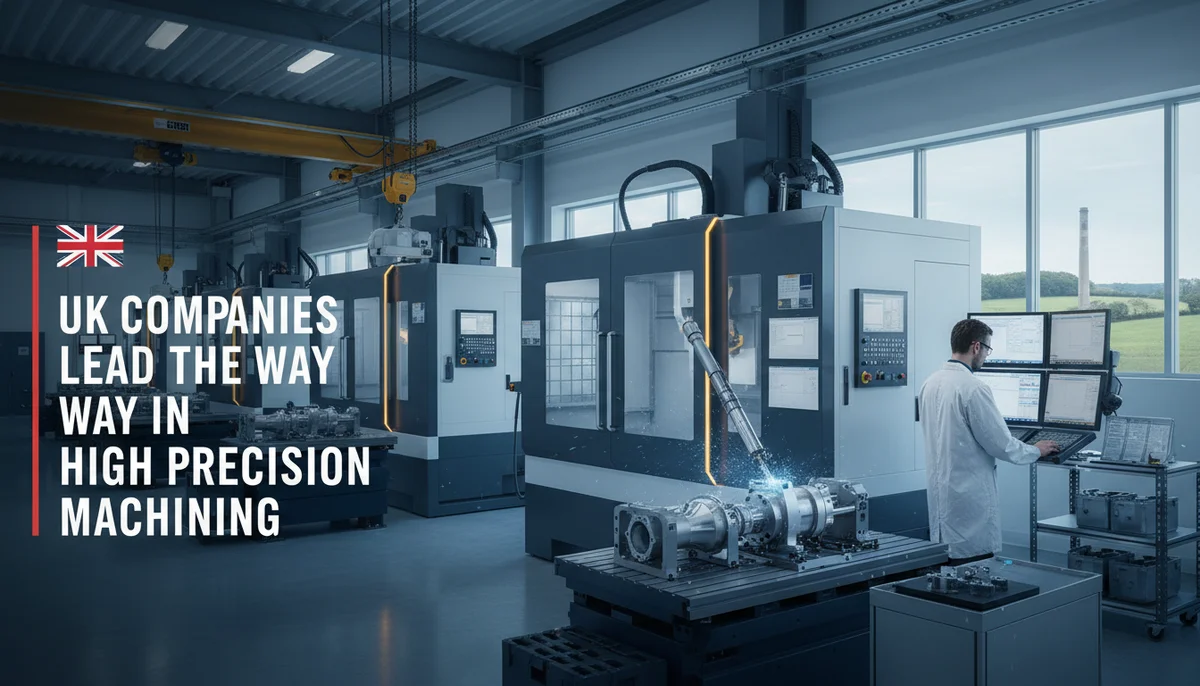
The UK is a world leader in the development of high precision machining, which is transforming industries.
High precision machining (HPM) allows companies to make products that could not have been made before, with accuracy and repeatability that would have been impossible just a few years ago. It can also help them deliver better quality products faster than before. While HPM still has some way to go before it becomes mainstream, its potential has already transformed many sectors by making things faster and cheaper than ever before. The following sections will explain what HPM is, how it works and where it's used – plus give examples of how some UK companies are using this technology to improve their business.
What is High Precision Machining?
High precision machining is an advanced manufacturing process that uses computer-controlled equipment to produce parts with high levels of accuracy. This type of production can be used in industries ranging from aerospace and automotive to medical devices, but it’s especially prevalent in the UK because of its ability to create complex shapes out of materials like titanium alloys or hard steel alloys.
High precision machining has been around since the 1960s when lasers first became available for use as cutting tools on CNC machines (computer numerical control). Nowadays these tools are commonly referred to as smart tools because they’re able to react quickly enough for high-speed production lines–and they’re also becoming more affordable thanks to advances in technology.
A Brief History of High Precision Machining
High precision machining has been around for centuries. The first high-precision machine tools were developed in the 18th century and they were used to produce scientific instruments such as telescopes, microscopes and clocks. In the 19th century, these machines began to be adapted for industrial use.
Today’s high precision machines are capable of performing operations on parts that have tolerances as small as 0.001 mm.
Where High Precision Machining is Used
High precision machining is used in many industries, from energy to aerospace. The most common uses for high precision machining are:
Turbines – These machines are used for energy production and distribution across the world. They require a high level of accuracy so that they can function effectively.
Medical equipment – This includes anything from surgical tools to prosthetics and implants; all of which need to be made with great precision in order to fit perfectly into the human body without causing damage or irritation during use.
Aerospace – Aircraft are highly complex pieces of technology which rely on several different components being manufactured precisely so that they work together seamlessly when assembled at scale (for example, an aircraft wing must fit onto its fuselage without any gaps between them).
The Benefits of High Precision Machining
High precision machining can be used to produce parts that are more accurate, reliable and durable.
These benefits are due to the fact that high precision machining allows you to create complex shapes from metal or plastic with greater accuracy than conventional methods. This increases the strength of your finished product as well as helping it last longer than products made by other means such as casting or moulding. High precision also makes it possible for companies who specialise in this process to create components with minimal waste material being produced during manufacture; this saves money on materials while reducing carbon emissions at the same time.
UK Companies Lead The Way
In the UK, companies are using new technology to increase productivity, quality, and efficiency. They’re also able to decrease costs while increasing innovation.
The increase in productivity comes from the use of computer numerically controlled (CNC) machines with high precision machining capabilities. These machines can be programmed to perform a number of different tasks at once, or individually depending on what the company needs at any given time.
The precision engineering industry in the UK is held to a high standard, and manufacturers produce a product that their clients can rely on. Clients who deal with precision engineering companies based in the UK have more confidence in the quality of their products because there are accreditations and mechanisms for quality control in this country.
Add to this the fact that UK precision engineering companies are easily accessible for customers to visit and see for themselves just what standards they are working to, well, it's a no-brainer really!
UK companies are taking advantage of the possibilities offered by new machining technologies.
The UK is leading the way in high precision machining. With new technologies, companies are able to produce better products and be more efficient.
The use of robotics, additive manufacturing and high speed machining is becoming more common-place across industries such as aerospace and automotive. These developments have been spearheaded by UK companies who are taking advantage of these possibilities offered by new technologies
The future of high precision machining is exciting, and UK companies are leading the way. With new technologies like 5-axis and laser machining, we can expect to see even more complex parts being produced with greater speed and accuracy than ever before.