
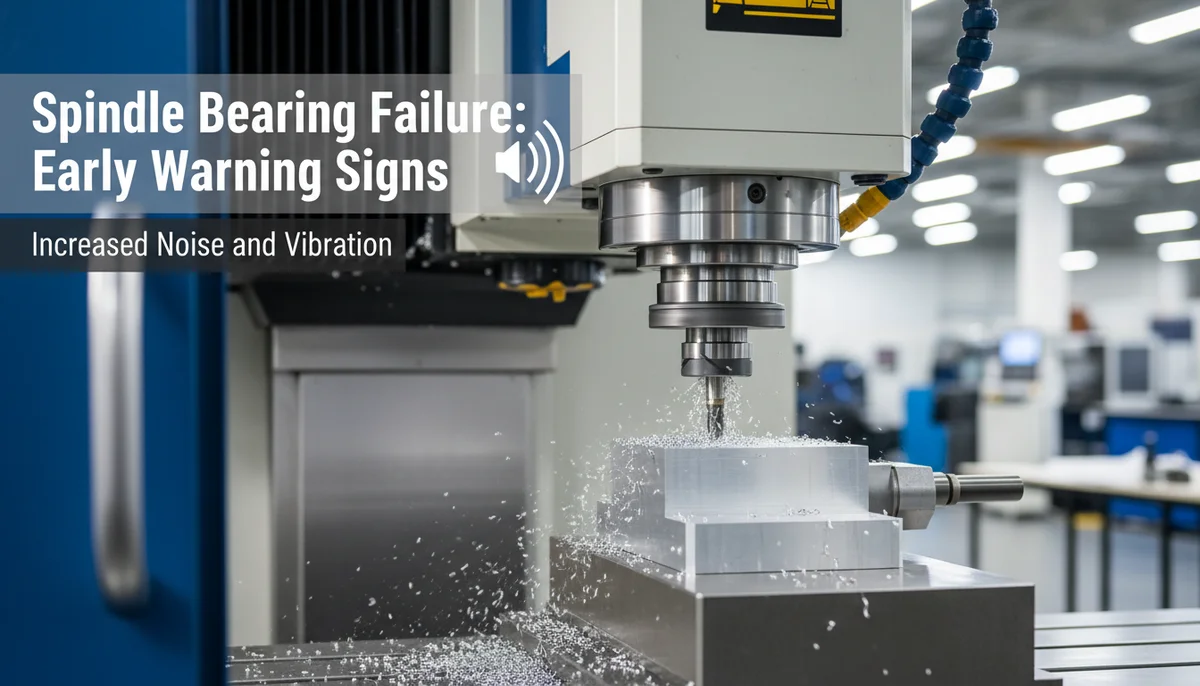
A healthy spindle should sound consistent, run cool within expected limits, and hold tolerance under load. When bearings begin to degrade, operators often notice subtle changes first: a rising whine at specific RPM bands, localized heat around the nose, or a slight surface finish deterioration that appears and disappears between tools.
In many workshops, these warning signs get dismissed as tooling variation or material inconsistency. The problem is that bearing wear is progressive. Once preload is compromised, axial and radial play increase quickly, and the spindle can start transferring vibration into the tool, holder, and eventually the taper interface.
The Progression of Bearing Failure
Bearing failure rarely happens suddenly. It follows a predictable path: first, the lubricant film breaks down in localised areas. Then metal-to-metal contact begins, work hardening the rolling elements and raceways. Preload drops as the bearing seats wear. Within days or weeks — depending on cutting loads and spindle hours — you'll see the tell-tale signs: heat spots on the spindle housing, a new vibration frequency in the audio signature, or a chatter mark on components that previously ran clean.
The cost of ignoring these signals is significant. A spindle that could have been saved with a £400–800 bearing replacement often ends up needing a full spindle rebuild at £3,000–12,000, plus lost production time and potentially damaged workpieces.
What to Listen For
Run the spindle at a consistent RPM — typically the most common cutting speed for your operation — and listen across the frequency range. A healthy spindle is relatively quiet; any grinding, whirring at non-harmonic frequencies, or irregular noise should be investigated.
What to Measure
Using a dial indicator or laser interferometer, check runout at the spindle nose. Any reading above 0.003mm (on modern high-speed spindles) warrants investigation. Also monitor spindle temperature over successive cycles — a spindle that reaches thermal equilibrium at 5°C higher than its historical baseline is telling you something has changed.
Act Early
If you identify bearing wear early, the repair is straightforward: replace the bearings, check the taper for brinelling or impact damage, and re-establish preload. If you wait until the spindle seizes or the damage spreads to the shaft and housing bore, you're looking at a much more expensive repair.